
Representatives of the Ministry of Health, Office and Regional Public Health Offices of the Slovak Republic, as well as the Ministry of Education, Research, Development and Youth of the Slovak Republic and the Programme Manager - Ministry of Investment, Regional Development and Informatics of the Slovak Republic took part in the study visit of Switzerland on March 15 - 18, 2026 under the Swiss-Slovak Health Programme, which deals with the transfer of knowledge and examples of practice in the field of prevention and health promotion.
Following the study visit, a post-webinar and a survey were carried out on 31 March 2026, which provided room for reflection of participants. Experts, programme coordinators from MZ SR, ÚVZ SR and RÚVZ SR focused on issues of sight transfer from Switzerland for the Slovak context, for possible development and also on the challenges of improving prevention in Slovakia and health status of the population and indicators regarding preventable causes of morbidity and mortality.
In addition to the participants, the post-webinar included project representatives to be implemented at regional and local level.
The aim of the post-webinar was to reflect whether and how knowledge of the study visit is implementable in the Slovak Republic context; to get feedback from the players; and also to support the consolidation of partnerships (Slovak-Swiss as well as within the Slovak Republic at national, regional and local government level); planning of further steps, discussion of joint activities with components two and three.
In fact, this fully started the work of all three components - Programme together, state level, self-governing regions and cities.
The participants of the study visit were presented with Swiss experience from the management system and concrete implemented projects to prevent non-communicable diseases and promote health at different levels, federal, cantonal and local. The visit met the objectives (1) to strengthen the understanding of the architecture of the public health of Switzerland, (2) to understand the management and strategic management bodies of Switzerland's health promotion, (3) to become familiar with the activities of good practice, (4) to share and transfer with regard to the Slovak context, (5) inspiration and networking of experts.
The visit was preceded by discussions of experts during common webinars in cooperation with partner RADIX, visit of Swiss partners in December 2026 in Bratislava and the MIRRI conference in Banská Štiavnica in March, connecting the state, regional and local levels: https://swiss-conversion.sk/?p=1576&csrt=987217372919358679
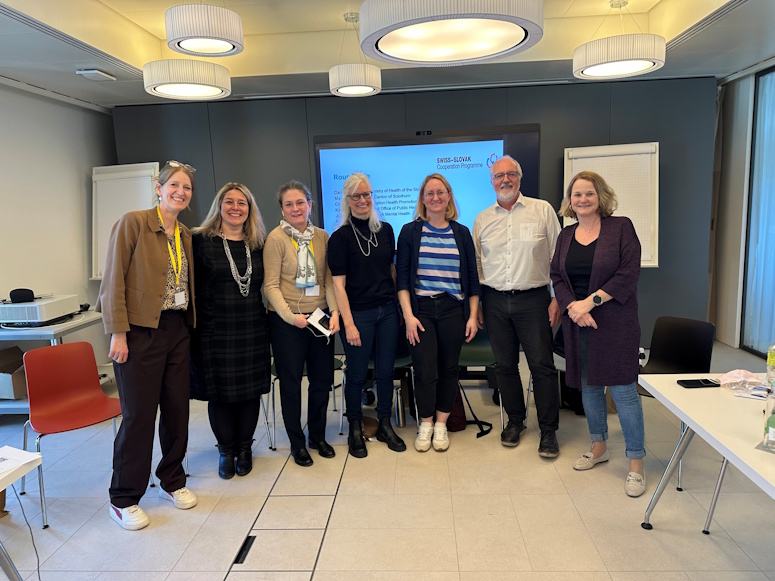
The study travel programme included:
- On the first day a visit to the Canton House in Bern and a meeting with representatives of the Swiss Agency for Development and Cooperation (SDC), the Swiss Contribution Fund, the RADIX Health Foundation and the Bern Health Promotion Department, a visit to the Canton of Solothurn Health, a formal meeting with the reception organised by the Federal Office of Foreign Affairs (FDFA) and the SDC.
- On the second day, experts met with representatives of the Swiss Health Support Foundation and a round table was held with important health support players in Switzerland, including the Association of Cantonal Health Promotion Offices, Health Promotion Cantony Solothurn, Mental Health Network, Policy lobby for the Health of Polsan. The Slovak side was represented by the professional guarantor of the project Daniela Kállayová.
- On the third day, specific project visits and meetings were held at the University of Zurich, its Institute of Epidemiology, Biostatistics and Prevention.
The Swiss party was represented by personalities related to the Swiss contribution programme, development activities and health prevention and support: Nils Rosemann, Programme Manager SDC, Ivan Hromada, Switzerland-Slovak Cooperation Office; Silvia Steiner, Director of the Association of Cantonal Health Promotion Agents, Cornelia Conrad Executive Director of the RADIX Foundation of Health Foundation, Stefanie Pürro, Head of the Health Support and Prevention Department of Bern, Susanne Schaffner – Health Director and Head of the Interior Department of the Canton of Solothurn, Manuela Meneghini, Head of the Health Promotion and Prevention Department of the Canton of Solothurn, Chiara Tester, Head of the CAP (Cantonal Action Programme) Swiss Health Support Foundation, Cornelia Waser, Head of the Development Department of the CAP Swiss Health Support Foundation, Raphaël Trémeaud, Head of the Health Prevention Department of the Swiss Health Support Foundation. Kathrin Favero, co-director of the Health Support Department, Swiss Health Foundation, Julie Page, co-director of the mental health network, Reto Wiesli, Polsan, political lobbying and many others.
Among the Slovak representatives who contributed to the visit was also the main sanitary officer of the Slovak Republic Tatiana Červeňová as well as Ambassador of the Slovak Republic in Switzerland Soňa Budayová.
Visitors shared their observations and the benefits of the visit in the form of responses to the MZ SR questionnaire and in the discussion during the post-webinar, organized online 31.3.2026, from which we choose:
- Complexity and width of access Switzerland to promote public health, systematically connecting the community, canton and federal level covers a wide range of target groups from early childhood to seniors.
- Projects in the programme Health is part of a larger European and global landscape and their positive outcome can contribute to the argument why Switzerland and its citizens should choose to invest in health in the EU in regions with inequalities, including Slovakia. The current positive scenario, based on signed cooperation packages at this stage, envisages tripling Switzerland's finances, invested in projects supporting the EU Cohesion Fund.
- The expert guarantor Daniela Kállay summarised the state of play in the implementation of the Health Programme Travel Map, where it is planned in the next period (1) the creation and development of skills of coordinators at the level of the VÚC and local government and their interconnection and networking (in which the current tasks are mapping of regions and public health players; the development of a health profile and more effective involvement of science and universities); (2) webinars with the Swiss partner of the RADIX Health Foundation; (3) screening of risk factors; (4) preparation of a portal of good practice; (5) markets of practice, which will provide room for the exchange of experience between different implementation activities at different levels; and how the culmination of health programme activities is planned to create (6) a functional management model that will bring changes to disease prevention and health support at all three levels of management, central, regional and local, with possible legislative and financial elements, if they prove professionally necessary, to which preparations will start, which will be discussed at the September pre-conference workshop of the international conference on 9-11 September 2026 in the Tatras V4 PHC 2026, with the possible legislative and financial elements of Healthy Healths in which they will become necessary, and are
- The positive dimension of lobbying and public health advocacy has been achieved by legislative achievements in tobacco legislation and by limiting tobacco promotion. On the other hand, the excellent scientific results of the project to add physical activity in schools were not sufficient for changes at central level in the number of hours of physical activity in the school system. The success of public health interventions at national level requires results, data to be accompanied by effective communication and, if necessary, lobbying, systemic and legislative changes.
- Prevention in Switzerland is considered to be part of everyday life, a certain standard. In Slovakia, systemic changes are needed in order to shift and we do not understand prevention as something beyond, instead of realising the cost-effectiveness of investments in prevention that save costs and improve the health and quality of life of the population.
- All were interested and taught the projects presented and the possibility of a practical experience with interventions focused on risk groups, seniors, (prevention of falls, loneliness), children (obesity, movement, nutrition through kindergarten and school interventions), socially disadvantaged groups (own-helping in the group of women/ men, identifying needs and solutions, promoting games and incentives for children's education in families); they were interested, as one project such as the Café Balance - a course of coffee rhythms for seniors can address several things at once, healthy ageing, preventing falls and improving the state of physical and mental health.
- Swiss Party represented by the Head of the Swiss-Slovak Cooperation Programme (SCO) Office Matthias Bachmann and programme manager Ivan Hromad expressed her pleasure in the success of the visit and the benefits of exchanging experiences for both parties. The visit focused mainly on issues of system management, cooperation of players, coordination, interconnection of different sectors, finance, central level with local, citizens, science. How politicians and those who decide on health and prevention funding are addressed and involved. Some specifics will need to be adapted in the Slovak context, but the exchange has contributed to new perspectives and to finding new possible solutions. A SCO plans to add its contribution in organising visits to partner projects and dialogues of relevant stakeholders.
They reminded us that prevention is a long road. Similar projects are developed in Slovakia and Switzerland in terms of feasibility. What Slovakia lacks is a framework for their sustainability, organisation and financing.
They would like to learn more about Slovak projects and their key factors for success. The Slovak Republic has established structures at national, regional and local level, which they consider to be a good basis on which to build. Remarkable is how Slovakia is ahead in screening programmes, at national level. This is not as developed in Switzerland as they would like, and that it is organised by cantons from the regional level, is a certain disadvantage and creates differences and reserves on the principle of equality.
Coordination is considered to be one of the key factors for the success of the Swiss model. Coordination takes place on a multi-level basis A) At the level of relevant players at national, cantonal, local, including communities and NGOs B)More-level, not only vertically but in different directions. C) coordination in terms of knowledge and evaluation, D) coordination at political level E) coordination financial F) coordination within individual projects specifically under a larger programme than in Slovakia under the Health Programme.
The current state of coordination activities in Switzerland has developed over 20 years.
- Link at strategy level. The Swiss environment is stimulating in terms of strategic adjustment, the federal strategy sets the basis, but the direction, priorities given by the cantonal minister and health promotion implements the canton that reports to Parliament and compares the state before and after the implementation of projects. The Health Programme builds on the strategic framework for health care and the Programme's activities will result in its updating, linking with the government vision 2040 and updating the new cardiological action plan.
Thanks to Slovak-Swiss cooperation we can work on the effectiveness of measures to shift the level of preventive health care in Slovakia. Swiss support is crucial for the implementation of innovative solutions in self-governing regions and cities.
The program Health SR pursues the following objectives:
- increasing participation in prevention programmes by 40% by 2030;
- reducing the incidence and mortality of cardiovascular and cancer diseases;
- saving healthcare costs due to less need for advanced disease treatment;
- improving citizens' health literacy and proactive access to their own health.
Switzerland-Slovak Programme Health is built on the principle of Health in all policies, which focuses on integrating health into different sectoral policies in order to improve public health and achieve wider social benefits (see annex on the Health Programme).
A leaflet for parents to promote the mental health of their children