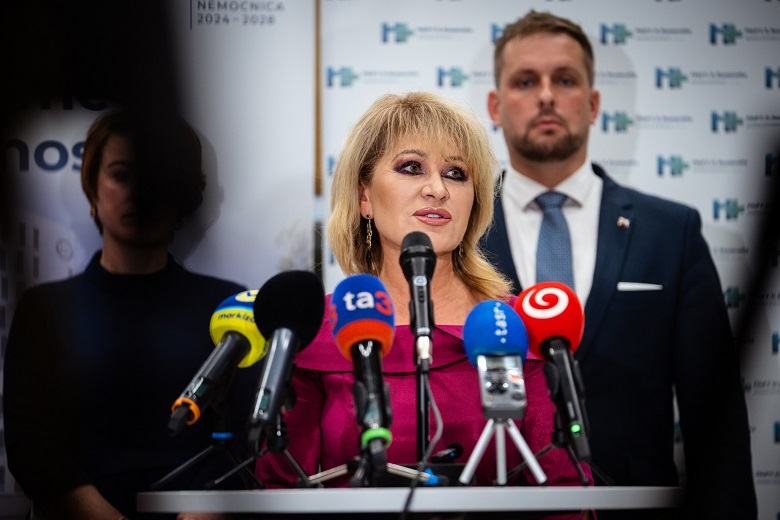
The Slovak transplant program recorded several remarkable achievements last year. Among the most important are the so-called ABO incompatible kidney transplant, when blood groups are incompatible with the donor and recipient organ. Slovak doctors also transplanted the kidney HIV to a positive patient with subdued HIV activity. Last year, last but not least, the Langerhans islet transplant took place for the first time in Slovakia, thus significantly moving the transplant program forward in Slovakia. On the occasion of World Transplant Day, Minister of Health Zuzana Dolinková and the doctors behind the transplant program evaluated. Thanks to him, 185 lives were saved last year. The ambition of the Department of Health and the Slovak Transplant Society is to expand the donor program to include heart stopped donors.
–Our common ambition is to reduce waiting times for vital organs, prevent premature deaths and increase transplant counts. I am therefore pleased that, after the COVID-19 pandemic, which has had a negative impact on transplant programs worldwide, we have been experiencing a gradual return to withdrawal and transplant activity from before the pandemic for the last year and a half. The Ministry of Health has long supported the campaign Seven lives and activities of professional companies that aim to promote donation and organ transplantation. It is true that more needs to be said about transplants, and in this respect it is precisely the information and educational campaigns that have an impact on society as a whole that have proved successful.Zuzana Dolinková, health minister, said.
185 lives were saved in Slovakia thanks to the transplant program. From 1 January 2023 to 31 December 2023 we have implemented a total of 164 donations, including 148 from dead and 16 from living donors, says Prof. Ivana Village, PhD., FERA, president of the Slovak transplant society. In terms of sampling statistics, out of a total of 164 samplings 84 kidney, 51 liver, 23 hearts and 1 pancreas were performed. If we look at transplant statistics, last year there were 186 organ transplants in Slovakia, of which 128 kidney transplants, 17 heart transplants, 40 liver transplants plus one Langerhans islet transplant. Our goal is to further develop international cooperation in organ transplantation, develop a transplant program from living donors and build a national pair exchange programme for incompatible couples. supplied by Prof. Village.
However, Slovakia wants to extend the donor programme to those with stopped cardiac activity, following the model of other European countries. This applies, for example, to patients whose heart stopped for various reasons (such as injury, heart attack, others) and heart arrest is irreversible. This programme has already been launched, for example, in the Czech Republic, France, Spain, the Netherlands, the UK or Sweden. We would also like to develop it in Slovakia, as it is the way to increase the number of organ donors and thus the number of transplants,says MUDr. Martin Chrastina, PhD., CETC, main transplant coordinator.