
After taking office, Minister of Health Zuzana Dolinková announced that her first effort in the remaining weeks of 2023 would be to box more financial resources for the resort. Despite the unfavourable state of public finances, 955 million euros more than in 2023 have been secured for 2024. Overall, it will send EUR 7.97 billion to health care. We are not only responsible for increasing resources from the Ministry of Finance, but also for consolidation measures.
The establishment of the budget for the health sector for 2024 was based on the expected reality in 2023, in which less than EUR 6.9 billion was transferred to public health insurance. This item has been added to inflation, an increase in the consumption of medicines, the valorisation of health workers' wages as well as an increase in health care consumption due to the ageing population. Without policy change, analysts at the Ministry of Health of the Slovak Republic worked with less than 7.4 billion Euro.
To this amount, costs of over 300 million were added. Euro for the operation of health insurance companies, as well as compulsory contributions to the National Health Information Centre (NCZI), the Health Care Supervisory Authority (ÚDZS), the Health Service Operations Centre (OS ZZS) and the National Institute for Value and Technology (NIHO). Therefore, in an effort to consolidate, the Ministry has adjusted the contributions to these institutions on this point.
The contributions are set as a percentage of the total amount of public health insurance premiums in the previous year, i.e. the contributions paid next year are determined on the basis of resources in 2023. In 2023, healthcare expenditure increased significantly beyond expectations, given the exceptional increase in health workers' salaries as well as the sector's funding in October this year.
These contributions were most recently increased in 2022, when a total of 0.55% of the public health insurance, 0.45% for OS ZZS and ÚDZS and 0.032 percent for the NCZI activity. These percentages were determined on the basis of the needs of the above institutions. At the same time, it was considered that the resources from which the contributions will be converted for 2024 would be significantly lower than the reality of 2023. It is also necessary to note that all the appointed institutions will have sufficient resources available after this consolidation change.
With this change, we have reached a total expenditure of almost 7.7 billion euro next year in budget-making without so-called policy changes. However, since health should not only stabilise but also move forward, the Ministry has identified priorities that will require additional funding next year. After counting the cost of these priorities, we get to a total of EUR 7.97 billion.
In particular, it is a problem with the non-financing of public hospitals, as well as an increase in production due to shortening waiting times, the implementation of the DRG, as well as the implementation of the optimisation of the hospital network. The Ministry's objective will therefore be to manage state hospitals more actively in the coming year and also to supervise more closely the financial results of state-owned health establishments.
Last year the Ministry of Health of the Slovak Republic was issued a program order which specified exactly how the funds from public health insurance should be reallocated in detail to the exact amount for a particular type of healthcare. We plan to issue the same decree in the coming weeks and in the year 2024, and it will include a detailed information document, which will be transferred by the decree to health insurance companies in order to explain the best possible reallocation of resources to individual health sectors.
Finally, if the austerity measures from the expenditure review, as well as other identifiable and implemented austerity measures, can be enforced, a margin of almost 100 million will be created. Euro for the implementation of the list of health performances in the outpatient sector in the second half of 2024, and thus for a more equitable funding and better accessibility of outpatient healthcare.
Budget expenditure must be covered by revenue. These for the health care sector are the dominant two resources: the contributions of the economically active population and the so-called payment for the State's policyholders, i.e. the transfer from the State's tax resources. The second consolidation measure, which was proposed in the framework of the package of consolidation measures approved by the government of the Slovak Republic, is thus related to budgeting. This is an increase in the rate of public health insurance premiums from 1 January 2024. In particular, the premium rate will be increased by 1 percentage point for the employer, the self-employed and the self-payer.
As the premium rate is determined on the basis of the assessment base that is individual to each payer (e.g. the SZP assessment basis is in the amount of the share of the income tax base not reduced by the levy paid and a coefficient of 1,486), it is not generally possible to say what amount in euro this levy will increase. Specifically, the percentages are shown in the table below.
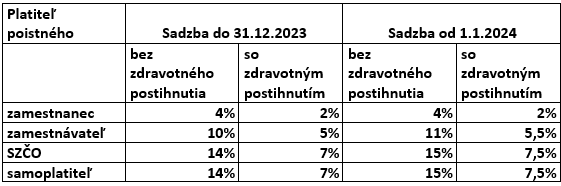
The increased levy will bring approximately 400 million. EUR extra resources next year. In combination with the payment for insured persons of the State, the SZP's expenditure is thus covered 7,97 billion Euro mentioned above.