
Minister of Health Vladimír Lengvarský presented together with the team the biggest health reform in the last 15 years. Patients will receive quality and accessible healthcare and better management, as well as better health care and quality working conditions for healthcare professionals.
Vladimír Lengvarský, head of the health department, stressed that this was not a disturbance of hospitals. The reform is designed to provide patients with high quality, affordable health care and doctors, nurses, and other healthcare professionals with quality and decent conditions for their work. At the same time, it will strengthen the bed fund of follow-up and long-term care and create room for healing, but also better conditions for chronically ill patients, stated Minister for Health Vladimír Lengvarský.
The reform of the hospital network is linked to further reform steps such as optimising the network of acute health care, a new definition of urgent healthcare, a reform of the provision of general adult care, children and adolescents and others.
The reform foresees acute beds that guarantee the provision of quality healthcare, additional beds will be the primary beds of subsequent healthcare that are currently lacking in the system.
The primary primary outcome of the reform will be to define the patient's entitlement - what kind of healthcare to receive, at what distance from residence, until what time from diagnosis and under what conditions and in what quality.
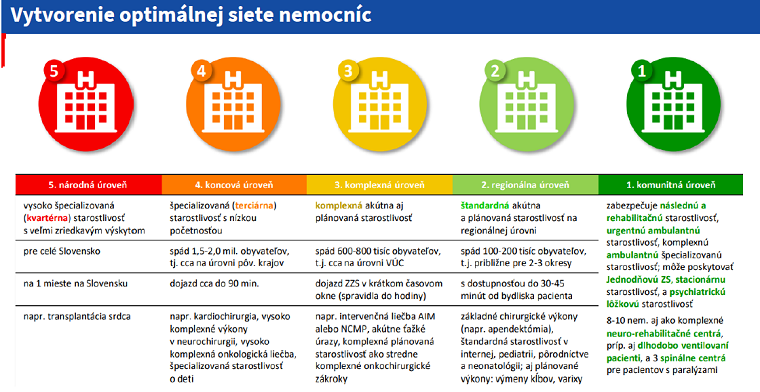
National level - highly specialised care with very rare occurrence. It will only be in one place in Slovakia, for example, there will be a heart transplant. End level - specialized care with low frequency. Between 1.5 and 2 million inhabitants will fall into it. The range should be within approximately 90 minutes. For example, there will be highly complex oncology treatment, cardiosurgery or highly complex neurosurgery.
Complex level - comprehensive emergency and planned care. Between 600.000 and 800.000 people will fall below this level, i.e. around the level of the higher territorial unit (VÚC). The range of medical emergency services should be in it within about an hour. In this case, for example, there could be acute severe injuries or complex planned care such as moderately complex oncosurgical interventions. Regional level - standard emergency and planned care at regional level. Approximately 100,000 to 200,000 inhabitants will fall into it due to approximately two to three districts with access within 30 to 45 minutes of the patient's residence. Basic surgical procedures or standard care for internal, paediatric, midwifery, as well as planned tasks such as joint exchanges should be carried out at this level.Community level - follow-up and rehabilitation care, emergency outpatient care, comprehensive outpatient care, specialist care, can provide overnight healthcare, stationary care, psychiatric and bed care. There will be eight to ten hospitals as complex neurorehabilitation centres, possibly long-term ventilated patients and three spinal centres for patients with paralysis.