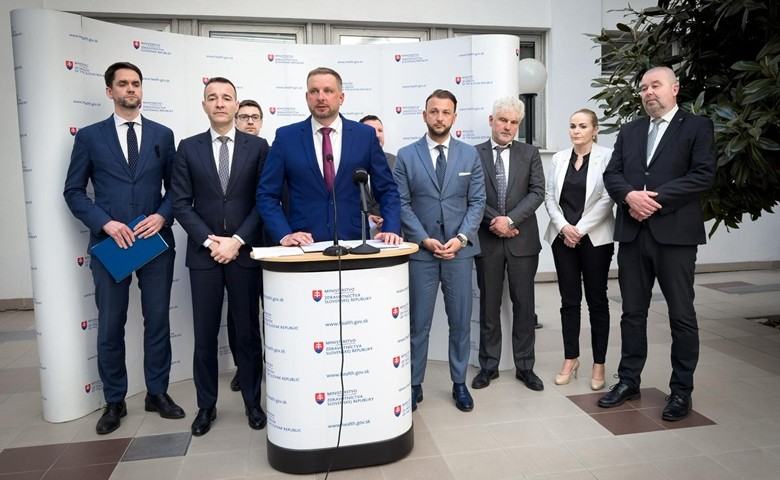
Already the third round table on the theme "Building of expertise and system coordination in the field of prevention of radicalisation and violence" took place on 8 April 2026 with the participation of the Minister of Health of the Slovak Republic Kamila Šaška, Minister of Interior of the Slovak Republic Matúš Šutaj Eštok, Minister of Education, Research, Development and Youth of the Slovak Republic Tomáš Drucker, State Secretary of the Ministry of Justice of the Slovak Republic Michal Sedliak and State Secretary of the Ministry of Labour, Social Affairs and Family of the Slovak Republic Marián Valentovič.
The representatives of the five departments agreed at the highest level that the -radicalisation- and -deradicisation- are separate specialised areas and need to be regulated by specific legislation. Prevention of radicalisation or mobilisation of violence must not lead to the labeling and stigmatisation of young people.
The Ministry of Health does not come up with a security or repressive solution to the topic of radicalisation. The department's contribution consists in creating a system of psychosocial support in the field of mental health. This system is designed to strengthen the safe environment, relationships, resilience, availability of aid and thus to reduce part of the risk factors of radicalisation. In order to prevent the radicalisation of young people, a system of psychosocial support in the field of mental health and a fund should be established to finance preventive, community and group services reducing risk factors for radicalisation, while radicalisation itself will be governed by specific legislation, said Health Minister Kamil Šaško.
The Mental Health Fund is intended to finance services that are now demonstrably lacking and meet qualitative, technical and systemic criteria. It is also intended to determine the conditions under which they can be supported. It is not intended to be a parallel system for healthcare, but a tool for relieving and supplementing it. The forthcoming legislative framework is also a follow-up to the need for rapid and coordinated action.
The legislation under preparation is designed to establish a functional framework for cooperation between different sectors and to make data sharing more efficient so that problems can be identified in the early stages. The solution also includes the development of a psychosocial support system that complements the existing health and social care system and allows for the provision of assistance of appropriate severity of the situation as close as possible to the child's natural environment.
I am pleased that this third round table was held at the Ministry of Health, because we believe that the mental well-being and mental problems of children and young people are the biggest source of aggression and radicalisation, and consequently there are feelings of danger. We presented the results of research among young people, which also showed how important it is for children and young people to feel secure. To VIII. Parliament's meetings of children and young people decided, on the basis of a proposal from young people, that we would draw up a proposal for first psychological assistance, as a basic tool for eliminating mental ill-being in children and youth groups," said Commissioner for Children Jozef Mikloško.
According to Marek Madra from the advisory centre IP practice shows that radicalisation of young people does not start with violence, but with thinking about themselves, others, and the world. It is at this stage that we often fail as a system, we react late and unconnected. Young people are gradually getting out of the system, either not getting to help in time or falling out of it, even though they are in contact with various services. At the same time, a large part of these processes take place in an online space where the system is still not sufficiently present. If we want to prevent these situations, we need a system that cooperates, that can keep a young person in the process of helping and that works not only with symptoms but also with beliefs. Otherwise, we will continue to catch up instead of preventing them. I see these round tables as an important step towards change. We are approaching a concrete form of a solution that has the ambition to capture risk situations in a coordinated and systematic manner and offer young people early and accessible assistance, adds Marek Madro.
On the subject of mental health, this is a broader issue concerning security, stability, relations, respect, the ability to talk about difficulties and the availability of support. As the National Mental Health Programme states, the mental health care system must act as a pyramid. Around 2 to 6% of people need a psychiatrist, 20 to 25% need specialised or general non-specialized services. Around 75% of people need a different layer of assistance The aim is to capture the problems in time, to reduce the risk of deterioration, to use a dedicated system only where it is really necessary and to get help appropriate to the severity of the situation and as close as possible to the natural environment.
Psychosocial support services do not fall under the standard social services nor under the provision of health care, but fill the space between them. They help people before their situation reaches a clinical problem. Their role is to prevent, capture difficulties in a timely manner, promote ongoing recovery and support recovery.
What services to create:
- Information and prevention activities
- Improving basic aid skills
- Peer support and work with experienced personal experience
- Group activities and professional workshops
- Non-clinical advice and other forms of individual and group aid
- Support should be given not only to young people but also to parents, teachers and other adults who shape them.