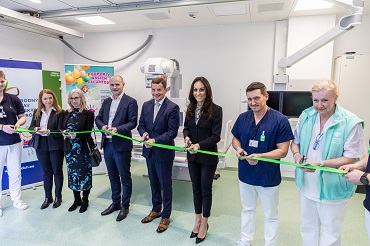
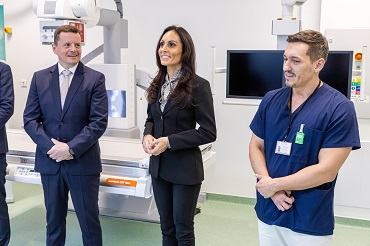
V The National Institute of Children's Diseases, with the participation of the Minister of Health Zuzana Dolinková after the reconstruction, were today opened two workplaces of the Radio Department of CT and Skiascopic-skiagraphic Department. In addition to the reconstruction, the radiological workplace also acquired new high-end equipment. The new devices represent an improvement in the three main pillars – in the speed, quality of the examination and reduction of radiation dose.
I am very pleased that it has been possible to reconstruct the workplaces of the Radio Department, which will help improve the diagnosis and subsequent treatment of our smallest patients. At the same time, I am very pleased that we have found the means to reconstruct and purchase equipment from the department's capital expenditure so that our children's patients can be treated in such beautiful modern spaces, which will also help them to better handle important investigations, said Minister for Health Zuzana Dolinková.
,,The highest benefit is the significant shift in the quality of the key component of the healthcare provided, the diagnosis of diseases, the monitoring of their development over time and the assessment of treatment success. In children's patients, the first contact with the workplace where the examinations themselves take place is very important. A pleasant environment can distract attention from the examination, the child cooperates better and thus increases the speed and accuracy of diagnosis. The environment thus becomes an important component of the healing process. Improving the quality of the working environment and new high-quality technical equipment also contribute to the satisfaction and greater working efficiency of health professionals, said MUDr. Peter Barton, director of the NÚDCH and thanked the Ministry of Health for the financial support for buying equipment and also the colleagues and parents of small patients for their patience during the reconstruction.
Reconstruction and purchase of equipment in the amount of 1 855 532 € were reimbursed from capital expenditure of MZ SR.
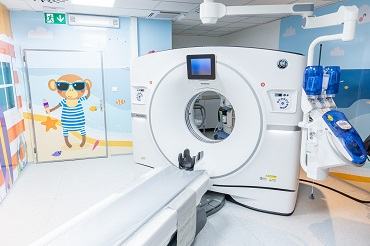
At the CT workplace, children's motive on the walls in the form of wallpapers with animals attracts the attention of the patients, with the main theme coming from the name itself, "Beach ZOO" which attracts children, distracts them from examinations and calms them down. This will improve cooperation between children and staff. During examinations, it is often necessary for children to remain motionless during the investigation and to cooperate, for example, in the form of breath retention during the examination. Equally important is the factor of working with state-of-the-art technology in radiodiagnostics and thus the professional progress of medical staff.
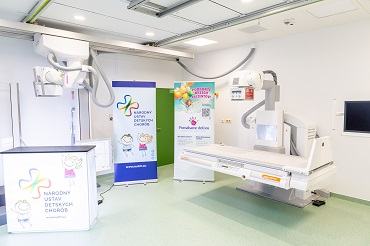
The new Skiascopic-skiagraphic tilt wall is essential for examinations with contrast agent. , These are mainly gastrointestinal tests, such as congenital developmental defects, post-operative status monitoring, urology testing, urinary excretion imaging, bladder filling and reflux monitoring in the renal excretion system, localization of foreign bodies, which is a relatively common phenomenon in children,Says MUDr. Stefan Pavlík, chief of Radiology Department.
It is also important for therapeutic performances such as the obstruction of the gastrointestinal tract of the type of invagination, which is popularly said, the gut in the intestine and its subsequent desinvagination. Also for the treatment of narrowing of the esophagus on the congenital or acquired substrate, e.g. ingestion of corrosives, using balloon catheters with the participation of anaesthesia. The wall allows recording the entire course of the examination, then its possible detailed evaluation, which is necessary for the correct diagnosis. Part of the workplace is also a " vertigraf ," which allows examination of e.g. whole limbs for a single scan of the entire spine and scan of the entire spine e.g. in the pre-surgical preparation of surgery treatment of scoliosis and consequently the display of its success, completed the primary Radiology Department.
New CT device the dual energy type will significantly improve the quality of the examination. At present, it is one of the most modern technologies used, which has specific applications in almost every medical field, but especially in oncology, surgery and neurosurgery. , allows virtually non-contrast imaging, thus reducing the number of examinations with a contrast agent that presents a certain stress to the kidneys. Also imaging blood vessels in better elimination of surrounding bones, which are a limiting factor. It also makes it possible to determine the composition of kidney stones, the representation of oedema (swelling of bones), which was only possible by magnetic resonance, to improve the diagnosis of embolism in the lungs, to allow the exact location of pulmonary embolism, as well as the elimination of metal artefacts such as endoprotheses, dental machines which were a limiting factor in the assessment of CT scans, said MUDr. Stephen Pavlik.
Both new devices represent an improvement in the three main pillars of - at the speed, quality of the examination and reduction of the radiation dose. ,"Rapid testing reduces the need for anaesthesia in a significant number of patients and eliminates artifacts from exercise. The quality of the examination will improve the resolution of the examination itself, leading to faster and better diagnostics. And last but not least, it's a radiation dose that's eliminated to a minimum while maintaining diagnostic quality, summed up the benefits of primary RO.
Radiology Department NÚDCH (RDG) provides a wide spectrum of radiological examinations. Last year, 84 393 performances were performed in this workplace. The main focus of the RDG department are non-invasive and invasive investigative methods of children under 18 years and 364 days. Investigative methods shall be applied to diagnose congenital defects and diseases of the gastrointestinal and urogenital tract, respiratory organs, blood vessels, brain and spinal cord as well as musculoskeletal apparatus. In addition to diagnostics, diapeutic medical procedures such as dilation of esophageal strictures, dilation and esophageal palsy, or the healing repositioning of invaginations are also performed.
RDG is one of the few workplaces in Slovakia, where genitography, dilation of GIT strictures, complete ultrasound preoperative, peroperative and postoperative diagnostics of liver transplantation and partial liver resections, kidneys, sonographic diagnosis of some birth defects of GIT and diaphragm are performed. Complete microscopic examination of the gastrointestinal tract.