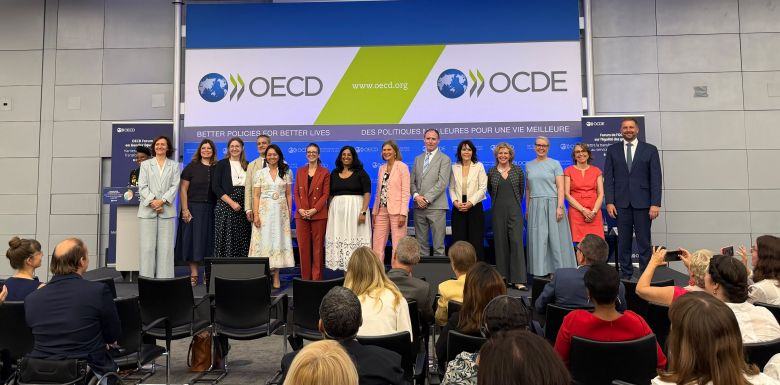
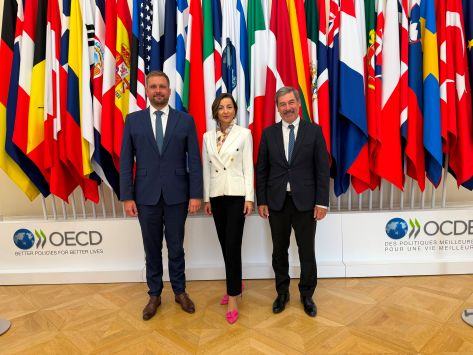
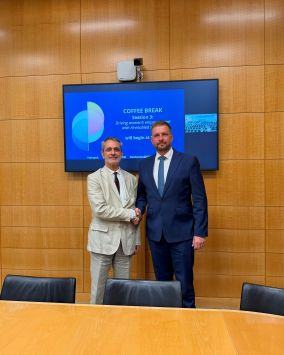
Slovakia relies on the largest health reforms on verified data and experience of the 38 most advanced economies in the world. Minister for Health Kamil Šaško has been negotiating for a long time with the leadership of the Organisation for Economic Cooperation and Development (OECD) on key changes in Slovak health and has also participated in the OECD Forum in Paris on Wednesday. The aim of OECD communication is to take on what is really working in other countries and to turn it at home into better access to healthcare for the patient and better conditions for health professionals.
We cannot rely on conjecture in reforms that affect the health of every single Slovak. We communicate directly with the best economists and health professionals in the world about what works and what does not, stated Minister Kamil Šaško. The Slovak health system cannot be an island for itself. We build reforms on hard data and proven solutions, not political promises, completed.
This is not a one-time activity Þ with the OECD we work together systematically and it is one of the effective ways to get to the top knowledge and experience that the Slovak patient and healthcare professional will feel directly at home. Until May 2025 Minister Šaško, Secretary-General of the OECD, Mathias Cormann, has opened up the topics of central procurement, hospital audit, artificial intelligence in the health sector and health system performance measurements. Recommendations for structural reforms were also made by the OECD's 2026 Economic Review of Slovakia.
Last summer I sent our experts to the OECD experts who brought home completely specific system solutions. reminded the Minister of Expert Mission of the Ministry of Health in July 2025. The cooperation is not only working in one direction, the minister and his team at the Ministry of Health prepares for OECD experts to come to Bratislava.
The outputs of this cooperation are already visible today. Slovakia has its own framework for measuring the performance of the health system (HSPA) - a tool that shows where care works - with 18 domains and 110 specific indicators. We have shown interest in participation in the international survey of experience and patient satisfaction (PaRIS), we are working on drug policy projects and a joint OECD project on more effective care provision, which is intended to include a professional meeting of international experts in Bratislava.
In addition to the panel discussion, the minister discussed with the main OECD economist Stefan Scarpett on the impact of structural changes in health and their impact on the sustainability of public finances. Health modernisation must go hand in hand with responsible management and decisions that will bring long-term benefits to both patients and health professionals.
In front of OECD experts, we also presented models for planning the future needs of health professionals, resulting from the National Strategy for the Stabilisation and Management of Human Resources in Health by 2040. It is also on this subject that high-quality data and international experience enable us to better plan education, strengthen health professionals and take decisions that will ensure that healthcare professionals are sufficient for future generations of patients;The Minister of Health Kamil Šaško closes.