
Znair cleaning prepares the inhabitants of Slovakia by more than one year on average. In the most affected municipalities the difference is even more pronounced, people there live more than two years shorter than in the cleanest areas. This results from a new scientific study of Slovak experts and researchers, which for the first time analyses the effects of air pollution on public health.
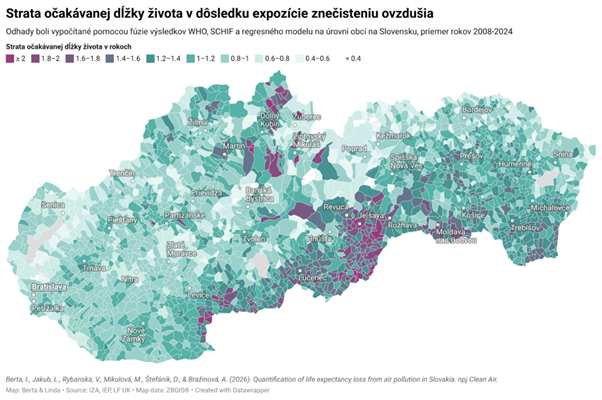
Figure 1: Shortening life expectancy due to exposure to polluted air at municipal level
The study provides a first comprehensive view of the impact of air pollution on the health of citizens throughout Slovakia. Scientists analyzed 935 057 deaths over 17 years and linked them to living population and air pollution data with PM2.5 particulate matter. They identified the regions with the highest health risk. The results show that the impact of air pollution is among the most important factors affecting life expectancy in Slovakia and is comparable to the differences associated with lower education.
Link to study:https://www.nature.com/articles/s44407-026-00085-2
In Slovakia, air pollution is not only an environmental problem but a key factor in public health. The results show that improving air quality can lead to a significant increase in people's lives. explained Imrich Berta at the Institute of Health Analysis.
The significant impact of pollution is not only felt in large cities or industrial regions. The problem is often even more pronounced in smaller municipalities, where solid fuel heating, especially wood, is widespread. It is such heating of households in Slovakia that the main sources of fine dust PM2.5 particles are also carcinogenic benzo (a) pyrene. The risk is further increased by the combustion of poor quality or poorly dried wood, says James Linda of the Institute for Environmental Policy. These substances are particularly dangerous to health as they penetrate deep into the lungs and increase the risk of cardiovascular and respiratory diseases.
Differences in air quality thus directly affect people's daily lives, from children's health to the risk of premature death. The most significant impacts are concentrated in regions with a higher share of local solid fuel heating. Higher concentrations of pollutants arise there by combining local emission sources and geographical conditions that limit pollution dispersion. The most affected areas are the south of central and eastern Slovakia, smaller areas in Orava and Liptov.
The results indicate that improving air quality could bring significant health benefits. Measures aimed at modernising household heating, promoting quality fuel and reducing emissions from local sources may have an impact comparable to other key factors affecting health, such as education or access to healthcare.
The study
A study of the Ministry of Health of the Slovak Republic, Institute of Environmental Policy (IEP) of the Ministry of Environment of the Slovak Republic, Faculty of Medicine of Comenius University in Bratislava, Slovak Hydrometeorological Institute and the Technical University in Brno. This is the first analysis of its kind in Slovakia and one of the few in the world that assesses the impact of air pollution on life expectancy at the level of individual municipalities.
Research combines modelled and measured air quality data with data on mortality between 2008 and 2024. It will assess the impact of the two main pollutants - fine dust particles (PM2.5) and benzo (a) pyrene. The model on Slovak data was compared by scientists with epidemiological formulas based on international studies.
The analysis allows for detailed identification of regional disparities and provides a new basis for public air and public health policy making. The results are robust but remain linked to uncertainties arising from air quality modelling and epidemiological relationships used.
Static map as PNG in high resolution:https://drive.google.com/file/d/1cZwxy25yq5MhQp5BZvI6AQjJ45EZOGz5/view?usp=sharing
Interactive map:https://datawrapper.dwcdn.net/Y1bc0/5/
The results of the analysis at the level are available at:https://docs.google.com/spreadsheets/d/1ltS5uOhjtnctz3geLorh4fRhB3buuP1umALnKIcJz 4/edit?usp=sharing