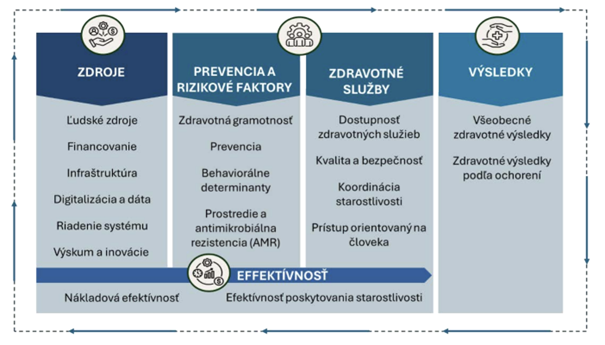
Institute of Health Analysis (IZA - analytical unit of the Ministry of Health of the Slovak Republic) recently presented the methodological report of Slovak Health System Performance Assessment (HSPA)the framework for assessing the performance of the health system.
HSPA is a systematic tool for measuring and evaluating health system performance. Through an appropriately selected set of country-relevant indicators, it enables a comprehensive capture of the functioning of the system, its results and areas requiring further improvement. The aim is to create a transparent and methodologically sound framework that supports data and evidence-based decision making.
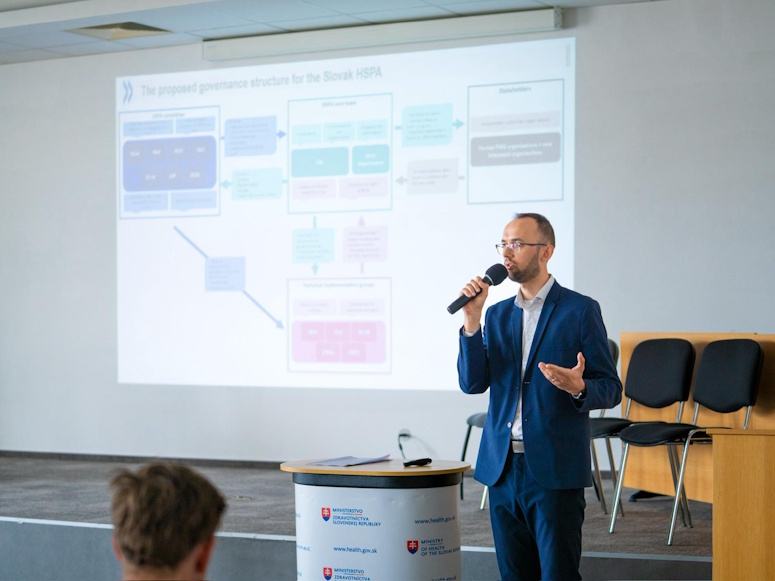
The event was opened by the State Secretary of the Ministry of Health Michal Štofko with the participation of representatives of the Organisation for Economic Cooperation and Development (OECD), who provides technical assistance in the project, and the European Commission, which finances this assistance through the Technical Support Instrument (TSI). Members of the Health Committee of the National Council of the Slovak Republic participated in the event.
The present methodological report summarises the approach to the creation of the Slovak HSPA framework, its structure, content and proposed direction for the future. An important theme of the event was also governance modelthe way HSPA is managed and coordinated in the next stages, including the division of roles and responsibilities of the various players in managing indicators, updating data and using outputs in practice.
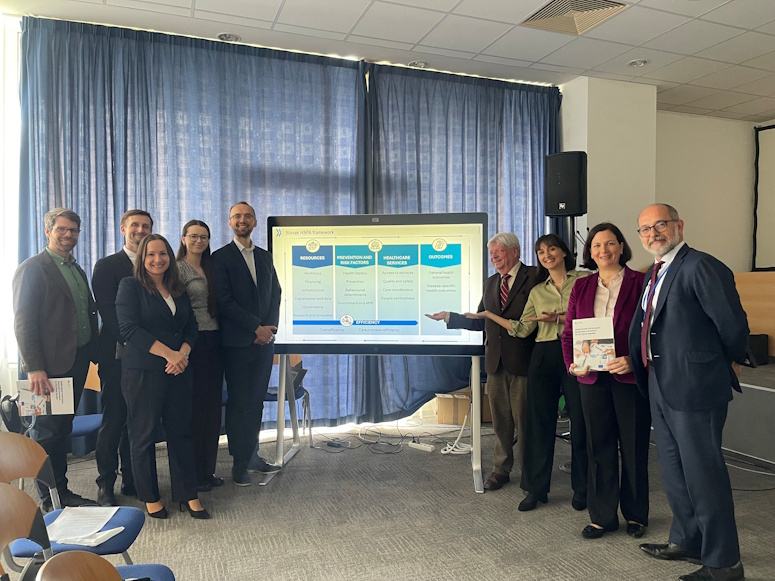
The event culminated in a panel discussion which confirmed the importance of cooperation between domestic and international partners in further development of the evaluation of health system performance in Slovakia.
The Ministry of Health is looking forward to further cooperation with all stakeholders involved in the project. The success of HSPA will depend crucially on continued coordination, professional cooperation and a joint commitment of the players to help improve the performance of Slovak health.

Online version of the methodological report
Summary of the methodological report:
- Document Draft Slovak HSPA framework as a tool for Monitoring of health system performance, improvement public reporting, responsibility for results and support evidence-based policy making. HSPA should monitor in particular Regional differences, time trends, international comparisons and quality of healthcare.
- Slovak HSPA framework 18 domains in 5 areas: resources, prevention and risk factors, health services, outputs and efficiency. The framework covers not only healthcare but also, in part, wider health determinants, e.g. social, environmental and educational factors.
- The Framework Is Fulfilled 110 Indicators, which were selected through Inclusive, multi-stage process with the stakeholders. The report stresses that the resulting framework should be Technically feasible and sufficiently complex, assuming its further refinement according to the development of data infrastructure.
- An important feature of the whole project is strong takeholder participation and shared ownership. State institutions, data administrators, insurance companies, professional institutions and other players were involved in the creation of the framework and indicators. The report thus builds the legitimacy of HSPA as a common tool, not just an internal analytical product.
- Content report not only remains within the framework structure: it also shows a practical example of use for equalityHow indicators can be linked across domains and used to detect inequalities in health and the system. The purpose of this example of use is that HSPA is not only a list of indicators, but a tool for Thematic interpretation of system performance.
- The key part for the future is the governance model. Report proposes 4 connected pointsto ensure the implementation, feasibility and sustainability of HSPA. The model is based on existing institutional responsibilities and project structures created during the development of HSPA; it is integrated around Ministry of Health through IZA:
HSPA Commission represents a strategic and decision-making level. It shall approve the scope and schedule of individual cycles, confirm or allocate resources, give a mandate to the organisations involved, continuously monitor progress and validate final outputs. It should also ensure that the findings of HSPA are used in decision-making and disseminated across sectors.
HSPA Central Team, led by IZA and supported by relevant MZ services, it should be at the heart of the implementation of the cycle. It has to prepare a detailed plan, coordinate inputs from technical groups, consolidate the analysis of indicators, revise the indicators, prepare and modify the report, communicate progress and organize a takeholder forum. In other words, the strategic input is to be converted into a realistic, time-driven and methodologically consistent output.
Technical implementation groups (TIGs) be of technical and analytical support to HSPA. They are composed of indicators and experts from institutions such as IZA, NCZ, ÚVZ, ŠÚ SR, insurance company or ÚDZS. Their task is to prepare and methodically refine the indicators, perform preliminary analyses, develop -placeholder-indicators and provide the Central Team with good quality backgrounds for creating the report.
The fourth layer is takeholderi as a wider community of HSPA users. They do not have a management or a major analytical role, but they should follow, interpret, spread in their organisations and give feedback on priorities, structure of reports and future cycles. This should maintain HSPA's relevance and its application across the sector.
- The report openly states that Slovakia does not yet have a formal legal mandate for HSPA. Therefore, the sustainability of the model will depend on clearly agreed roles, explicit responsibility for individual parts of the project, and mutual coordination. This is one of the most important ideas of the document: the governance model is well designed, but its strength will stand on whether it will be able to institutionalise responsibilities even without a strong legal anchor.
- Much attention is also paid to Data management. The report says that Slovakia has quite a strong basis for - key dates exist and often cover almost the entire population - but at the same time there are still problems with fragmentation of data management, limited sharing and data interconnection, duplicate reporting and manual processes. It will therefore be important for the successful HSPA to improve the secondary use of data, interoperability and flow automation.
- In terms of policy-making links, it is important that 80% of indicators (86 out of 110) has a link to existing national strategies and plans, either as indicators suitable for practical use or as indicators suitable for the purpose. This means that HSPA should not be a parallel project, but should be useful for monitoring existing priorities and reforms.
- For the future functioning of the report proposes Four-year reporting cycle, independent from the policy cycle to strengthen stability and analytical continuity. The reporting options are different, not only the creation of a full version of the report, but also dashboard, the summary of indicators, and in the future a separate website with regularly updated results and short comments on the indicators.
- The implementation plan is quite specific: in 2026 to prepare sample technical sheets for individual indicators, from the beginning of 2027 to start collecting and analysing data for the creation of the first report, with the aim of its publication at the end of 2027 and early 2028 respectively.