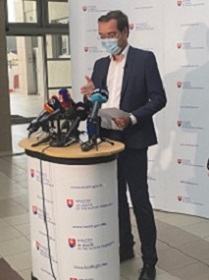
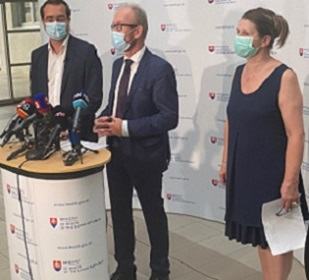
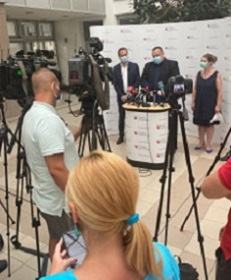
At the Ministry of Health, today the Pandemic Commission of the Government of the Slovak Republic, led by the Minister of Health Marek Krajčí, adopted the Pandemic Plan of the Slovak Republic. The aim of the plan is to ensure Slovakia's preparedness for a pandemic of acute respiratory diseases, the elimination of health and economic burden on the population, the operation of the economy, public life, the determination of the tasks of government, self-government and professional bodies that manage, provide and carry out activities in connection with ensuring the protection of public health. Under the new pandemic plan, the procedures for the second wave of the CVID-19 pandemic will be coordinated.
We have a second wave of a new coronavirus pandemic. I am very pleased that there has been a significant shift, we have a fully operational Pandemic Commission that has today adopted an important document that has set out clear operating rules, not only for COVID-19, but for every serious pandemic of acute respiratory diseases,– said Minister of Health Marek Krajčí.
The Pandemic Commission also examined the current situation regarding the Coronavirus pandemic in Slovakia. It agreed on a number of steps and actions. One of the proposals concerns the entry of children into schools and pre-school facilities. This is a so-called proactive measure. –If the child has not been abroad in the last 14 days, a parent's honest statement will suffice and can go to school. At the same time, we do not recommend that it be traveled abroad before the school year begins. Slovakia is still doing well compared to the surrounding countries; this needs to be remembered constantly, stated Minister of Health Marek Krajčí. Otherwise, the child will not be able to go to school. The possibility of avoiding quarantine in the home environment will be testing the child at COVID-19, but it will not be free. –We always have some epidemics in September, and it may be that the same class will come together, but as if a new team, as we know, will come together soon after half a year, it can spread very quickly, there is a risk of transmission to older groups and people who have some serious diagnosis, SaysPidemiologist Professor Henriette Hudeck.
At the same time, the Pandemic Commission proposes to convene an epidemiological consensus to advise it. This consensus will consider, inter alia, reviewing the list of risky countries and regions. Slovakia records dozens of diseases a day, we were counting on such a scenario, even expecting worse. We can say that other cases arise from import, the situation is not alarming at the moment, regional health care professionals are capturing these cases, it's ant work if we want to capture this second wave in time. said Chief Hygiene Officer John Mikas.
In addition, an operational centre of the Pandemic Commission is being established, which will operate as a so-called operational technical group at the time of the pandemic. Its task will be to exchange information on the implementation of the measures resulting from the pandemic plan under the responsibility of individual departments, operating centres, crisis staff of district authorities at the headquarters of the counties.
Currently, according to the pandemic plan, Slovakia is in phase 1. The Ministry of Health is preparing measures to implement reprofilization of the bed fund in designated economic mobilisation entities (University Hospital Bratislava, Faculty Hospital Trnava, Faculty Hospital Trenčín, Faculty Hospital Nitra, University Hospital Martin, General Hospital with Polyclinic Lučenec, Faculty Hospital with Polyclinic J.A. Reimana Prešov, University Hospital L. Pasteur Košice, Hospital with Polyclinic Š. Kukuru Michalovce and Children's Faculty Hospital Košice). In these hospitals, we will set aside space for so-called patients' covids. This will include 3 503 infectious beds, an average of 233 beds per hospital and according to the regional distribution of nearly 500 beds per respective region. These will only be available to patients with COVID-19 disease in Phase 1. Other hospitals will operate in standard mode. The epidemiological situation is monitored daily by regional public health authorities.
A further deterioration of the epidemiological situation and a further increase in infected persons would occur in the pandemic phase II. The fullness of the bed fund of infectious clinics and compartments is more than 50% and outbreaks occur. The Minister of Health at this stage will issue an order to perform the reprofilization of the bed fund by the economic mobilisation entities that have infectious clinics and departments (University Hospital Bratislava, Faculty Hospital Trnava, Faculty Hospital Trenčín, Faculty Hospital Nitra, University Hospital Martin, Central Military Hospital SNP Ružomberok, Faculty Hospital with Polyclinic F. D. Roosevelta Banská Bystrica, General Hospital with Polyclinic Lučenec, Faculty Hospital with Polyclinic J. A. Reimana Prešov, University Hospital L. Pasteur Košice, National Institute of Children's Diseases Bratislava, Children's Faculty Hospital with Polyclinic Banská Bystrica, Faculty Hospital with Nové Zámky and Nemocnica Poprad).
In the case of phase 3, Slovakia would re-establish the emergency situation. This would further exacerbate the epidemiological situation and further increase the number of infected persons. The fullness of the bed fund of infectious clinics and compartments is more than 75%, outbreaks arise that are quarantined by the competent district authorities on the proposal of the regional public health authorities. The aim is to slow down transmission and prevent the collapse of health care. Reprofilation would also apply to other hospitals designated by the Minister for Health as economic mobilisation entities.
The pandemic plan also includes so-called traffic lights for social services facilities, primary health care facilities and hospitals. According to these traffic lights, medical facilities will be reprofiled during the next onset of the pandemic. The Institute of Health Analysis of the Ministry of Health specified 14 indicators in three categories, on the basis of which the measures in a given county are transferred from green to orange to black. These data will be provided by the regional public health authorities, which will decide what to do, said Minister of Health.
The Pandemic Plan also defines the 4th phase of the "Pandemic period'.The chairman of the Pandemic Commission of the Slovak Government is the Minister of Health of the Slovak Republic, other members are:Minister for Interior, Minister for Defence, Minister for Transport and Construction, Minister for Agriculture and Rural Development, Minister for Finance, Minister for Economic Affairs, Minister for Labour, Social Affairs and Family, Minister for Foreign Affairs and European Affairs, Minister for Education, Science, Research and Sport, Minister for Culture, Minister for Investment, Regional Development and Informatics, President of the Administration of the State Material Reserves of the Slovak Republic, President of the Bratislava Self-Governing Region, President of the Banská Bystrica Self-Governing Region, President of the Region of Nitra Self-Governing Region, President of the Trenčín Self-Governing Region, President of the Prešov Self-Governing Region, Chairman of the Žilina Self-Governing Region, Director-General of Health Insurance Insurance, Chief Hygiene Officer of the Slovak Republic, Chief Expert on Epidemiology, Chief Expert on Infectology and Tropical Medicine, Chairman of the Slovak Academy of Sciences, Director-General of Crisis Management of the Ministry of Interior, Central Director of the State Veterinary and Food Administration, Director of the Health Department of Communication, Directorate of Crisis Management of the Ministry of the Health Ministry at the
The Commission may, as appropriate, set up regional pandemic commissions or expert working groups or invite other experts. The Prime Minister and members of the Government who are not members of the Board may also participate in the deliberations of the Commission.