Slovakia - model country WHO and ECDC system tuberculosis control and treatment in Central Europe
It can be said that it is as old as mankind, the first news of Tuberculosis comes from a time when people started to create more social cells. Already found skeletons from the younger Stone Age confirm existence bone form tuberculosis. The most common source of infection is a sick person, uncommonly animals or cadavers. Mycobacteria is infected approximately one third of the world's population. The most common entry gate is breathing the tract, as evidenced by the high proportion of lung TB, which accounts for up to 80-90% all forms of TB. The mycobacteria spreads through the air and into the body enter the airways by inhalation of tiny droplets that are formed by cough, sneeze or sing and persist in the air for several hours. More rare is digestive transmission or transmission by contact.
In countries with a high incidence of tuberculosis, active transmission is most common happening in homes and crowded places where large numbers of people gather people. The risk of developing an infection is dependent on several factors: infectiveness source, contact tightness, amount of bacteria inhaled, immune state the host system.
Current World Situation
In 2014, there were almost 9.6 million cases of tuberculosis in the world - 1 One million children, 3.2 million women and 5.4 million men. Tuberculosis (TB) you has claimed approximately 1.5 million deaths this year " were 140,000 children; 480,000 women and 980,000 men. Despite a dramatic decrease in total tuberculosis rates in Europe in the last 100 years are TB disease historical interest and European region defined by World Health the organisation (WHO) experienced an average 2.7% annual increase in cases in years 2004-2009. This trend has stopped since 2010.
58 008 cases of tuberculosis. Of the 480,000 patients infected World's multi-resistant strains of tuberculosis mycobacteria up to 73,000 has been identified within the European region. Total notification rate It was 12.8/100 000, but this reflects large differences within the region. From 2.5/100 000 in Iceland to 79.7/100 000 in Romania. In addition, significant There are also differences across countries. Increased incidence report major cities such as London (UK) with 38% cases in the total number of TB cases in the UK. Up to 26.8% cases in the European region have been reported in persons of foreign origin, i.e. born in the country where tuberculosis was detected and treated.
Current situation in tuberculosis in Slovakia
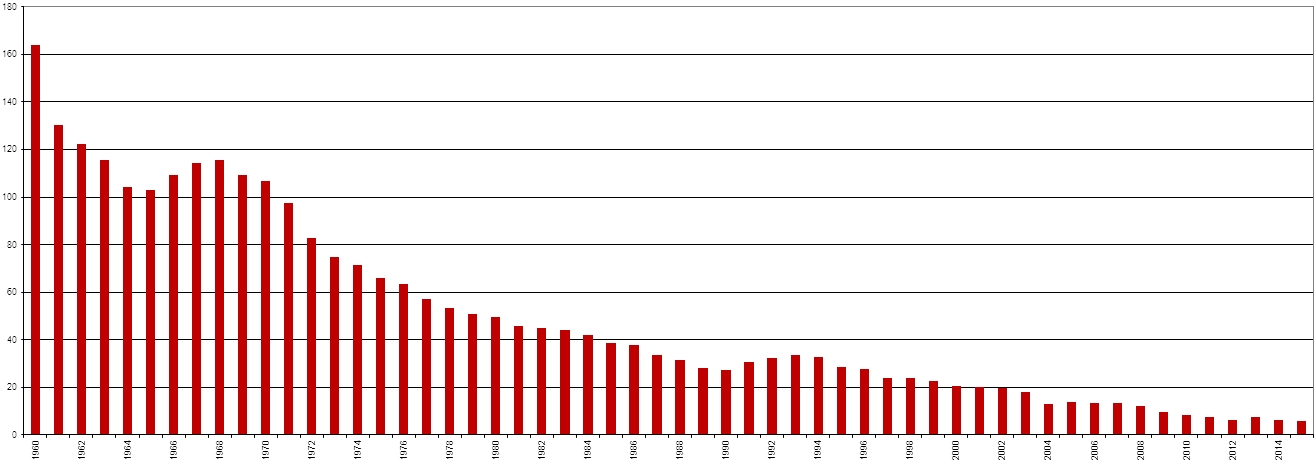
Today, the situation in Slovakia is stable. In 2014 The National TB Registry reported 336 cases of tuberculosis, which is 6,2/100000 inhabitants and 317 cases in 2015, which is 5.85/100000 residents.
In 2015, lung forms were in 264 cases, extrapulmonary forms in 53 163 cases (51.45%), total 203 cases verified (64.04%). In 11 cases, they were foreigners. V 286 cases of new cases and in 31 cases there were relapses. In the paediatric population below 14 years of age, tuberculosis occurred in 67 cases. Compared to 2014, there is an increase of 21 cases. Five died in 2015. tuberculosis patients.
Out of 317 cases, 221 cases were identified due to problems with control 4 cases registered, 54 cases in contact testing and 10 cases . In 2015 not one registered case of co-infection with TB and HIV infection.
According to geographical distribution in the Slovak Republic, the worst areas with
the highest incidence of this disease is the region of eastern Slovakia (Košický
the maakond of Izbez, and Prešovský kraj 10.98/100tis obiv.). Lowest
the occurrence is recorded in the Nitra region of 1,90/100tis.inhabitants.
Roma make up 37,22 percent (118) of the total number of cases.
In 2015 we had a total of 7 patients infected in Slovakia multi-resistant strains of tuberculosis mycobacteria. Analysis of results treatment for 2014 shows that the treatment our patients receive is fully indicated and correct, since we have up to 86% treatment success in the newly detected microscopically positive cases.
Objectives to be achieved from 1.7.2016 onwards Slovak Presidency of the Council EU
To address the issues of TB and point out our strengths with risk groups.
The current system of control and treatment of TB should be maintained for Slovakia as We serve ECDC and WHO as a model country in Central Europe that has appropriate monitoring and dispensation system.
Health experts call forimproved TB care for refugees has been discussed in professional companies and is currently preparing for Statement by Members of the European Parliament The Bureau is expected to launch a debate on the Health Ministers level, as the issue will be at expert level discussed and approved during 7th Conference European Region International Union for the Prevention of Tuberculosis and Pulmonary Diseases in Days 22.-24.6.2016 in Bratislava.
On the ECDC website Slovakia is given as a model country:
http://ecdc.europa.eu/en/healthtopics/Tuberculosis/Pages/interventions-examples.aspx
http://ecdc.europa.eu/en/healthtopics/Tuberculosis/world-tb-day/Pages/World-TB-Day-2016.aspx
http://ecdc.europa.eu/en/publications/Publications/tb-interventions-vulnerable-populations-policy-briefing.pdf
http://ecdc.europa.eu/en/publications/Publications/TB-guidance-interventions-vulnerable-groups.pdf
http://www.who.sk/international-day/world-day-tuberculosis 24 March -
World TB Day
Annexes
Notification of TB in Slovakia in 1960 - 2015